Why the private sector shouldn’t deliver aid

Delivering development and humanitarian projects is a big business, and a very profitable one. DFID will spend well over a billion pounds through the private sector in 2013-14, about 11% of its budget. This blog argues that using the private sector to deliver aid exacerbates some of the worst aspects of the development sector, leading to short-term, unaccountable aid projects.

Private sector contractors are typically selected through an open tender; competitors bid to win a contract, demonstrating that they can deliver quality outputs at the lowest possible price. Motivated by profit and drawing upon private sector expertise, contractors could be more efficient than NGOs, more reliable than local partners, and cheaper than direct delivery by DFID. It’s a seductive logic, and something we’re all familiar with; I go to the burger joint down the road because it sells the tastiest burgers at the lowest price.

However, open tenders encourage the winners to deliver aid in the worst possible way. Businesses typically win contracts for five years or less, and so have an incentive to focus on the short term. Cynically put, their economic interest is served by perpetuating the situation which they benefit from, rather than building local capacity or handing over to local partners.

Moreover, the accountability of private sector contractors is exclusively to their funder. There is no incentive to involve local communities in their work, which slows programmes down and costs money. Effective monitoring and evaluation can be deprioritised; why spend money on something which might make you look bad?

Of course, you could level similar accusations against other methods of delivering aid. In particular, NGOs are also dependent on funders, and tender for bids. Perhaps NGOs have a moderate countervailing force; they’re generally set up with an explicit social rather than financial purpose, which can affect the incentives that the staff work under. At some level, most senior managers in NGOs are required to care about more than burn rates and deadlines. In private sector contractors, by contrast, directors are often not from the development sector, and will have no institutional incentive beyond profit (even if they do have individual beliefs or desires to help). (See the comments below for more discussion on this.)

A lot of the current problems in development and humanitarian work come from misaligned incentives. The people who deliver aid have little incentive to think about the long term, to listen to or involve the people who they are delivering aid to, or effectively monitor and evaluate programmes. The only way the sector will improve is if donors think harder about how to improve these incentives, perhaps through longer-term partnerships with organisations sharing the same aims. Spending more and more money through tenders to the private sector is a big step in the wrong direction.

Footnotes:

By ‘private sector contractors’ we mean operators that are primarily driven by a financial imperative. This doesn’t necessarily include all those working in the private sector – though if they’re not primarily driven by financial imperatives then I would view them more as NGOs.

This certainly isn’t an argument against engaging with the private sector. The private sector is a key source of income and employment, and a more functional private sector in developing countries (including increased access to multinational firms, I think) should be a key aim of development projects. That’s a very different case from saying that the private sector should be a significant deliverer of aid.

Finally, as you can probably tell, I am quite short of ideas for ways that donors and governments could genuinely align incentives so that deliverers of development aid are not encouraged to focus on short-term, unaccountable projects. Ideas welcome in comments!

Hearing Is Not Listening

“We’re fooling ourselves if we think they are listening”, the Feminist Task Force on the post-2015 process tweeted on 23rd September, ahead of the United Nations General Assembly.

Untitled2

The extensive consultations leading up to the General Assembly allowed for women and girls’ voices to be ‘heard’. But heard is not listened to, as Theo Sowa, chief executive of the African Women’s Development Fund (AWDF), knows. She says: “The U.N. has tried to reach people but it’s the usual suspects and large NGOs who are given a voice.”

The rhetoric on women’s empowerment has never been glossier. Everyone is now in favour of women’s rights, everyone will adopt gender mainstreaming into their processes, everyone would like to measure the participation of women vis-à-vis men.

Empowerment used to have a radical meaning. It used to mean change from the bottom-up, change that required actual shifts in power. But as Sharah Razavi from the UN Research Institute on Social Development points out, the term ‘empowerment’ can be understood very differently depending on who said it. Terms can be appropriated by the international community and voided of their radical content. Empowerment used to be a synonym of emancipation , used almost interchangeably by the UN in the early days of talk of gender and the 1993 Vienna conference on Human Rights. Today, I see empowerment is becoming a synonym of the ‘participation’. Participation is of course understood and being allowed to speak within existing structures and ‘enabled’ to raise a hand in within existing power relations.

What is the problem with the cooptation of a term by one powerful community that lacks radical vision? One consequence is in the imagination of development alternatives. When we have no word to mean actual shifts in power, our collective ability to imagine those shifts in power is diminished.

The post-2015 process is lacking in creativity, lacking in vision to devise an alternate economic system which inherently supports a decent life for all. We talk in glossy terms, using emotional imaginary and the seductive language of “partnership” to designate the relationship between a CSO working at provincial level in the Democratic Republic of Congo and an oil extraction multinational with shareholders to please.

This language is deceptive for those interested in real shifts in power structures.

Let’s seriously consider how women are faring. The Millennium Development Goal 5 on reducing maternal deaths by three quarters is not on the track to being met. This is arguably one of the easiest MDGs to meet: the causes of maternal death are well known, prevention methods are widely understood, and 60% of maternal deaths are concentrated in just 10 countries. Compare that with MDGs on “halving extreme poverty” or “developing a global partnership”. MDG 5 should be easy. But the investments required are not being made. At Muskoka in 2009, G8 leaders renewed their commitment to MDG 5. However, when investment falls short, and in 2013 progress towards MDG 5 is labelled as “alarming” by the UN, the glossy rhetoric of “gender empowerment” can only ring false.

In terms of financing, AWID’s recent report “Watering the leaves, starving the roots” shows that financing for women’s organisation is not shaping up to the rhetoric on the importance of women in development processes. Will aid seriously start flowing towards women, as Justine Greening announced how important the theme is to the future of UK aid? Will philanthropists like the David and Lucille Packard Foundation be the ones who make the difference in funding for women?

The true empowerment of women will take radical transformation: both at the level of financial flows to civil society and women’s organisations, and at the level of development vision. We need to halt the empty rhetoric before we lose sight of what words are supposed to mean. And it will take more than speaking up to be heard. It takes bravery to turn up to a development seminar, and, facing the barrage of smiles and nods at the mention of ‘gender empowerment’, make a radical statement that participation is not empowerment. But as much as the development community lacks many resources, I still want to believe that courage is not one of them.

Enjoyed the blog? Please leave a comment below – and see our internal discussions and debates on it at the rough notes

Rough Notes – Hearing is not listening

These are our rough notes on the blog post ‘Hearing is Not Listening‘ – our internal discussions and debates before we post. Click here for the main blog.

Q: What is the Feminist Task Force?

R: The Feminist Task Force is a global coalition of leaders of women’s organisations focused on framing poverty as a women’s issue in the lead-up to 2015, date when the Millennium Development Goals (MDGs) will reach their expiry target. The Feminist Task Force advocates for gender equality to end poverty as the United Nations General Assembly considers its options for deciding on what will come after the MDGs, known as the post 2015 process.

Q: I’ve heard very similar arguments to your one on empowerment made about the word ‘participation’ itself. Oxfam have a great book on this – Fuzzwords – which is free and well worth a read if you haven’t already. http://policy-practice.oxfam.org.uk/publications/deconstructing-development-discourse-buzzwords-and-fuzzwords-118173

R: Agreed, I have read sections of this book and it’s very good.

Q: I think you perhaps put too much focus on funding. Firstly, it seems to accept money as an indicator for good development. Secondly, your framing of maternal mortality as a technical problem – “prevention methods are widely understood” – sits uneasily with your point above about a ‘vision to devise an alternate economic system’. In other words, I don’t think maternal mortality is a      purely technocratic problem, and so more money would not necessarily help. Finally, I don’t think you establish that we’re doing any worse on MDG 5 than any of the other MDGs, nor that we devote less money to it (both of which you imply.)

R: It is true that the post emphasizes funding because funding is a easily measurable and comparable indicator of donor interest in a particular cause. However I definitely agree that funding is one part of the picture, and policies must also be considered. Maternal mortality is certainly not technical issues which can be quickly fixed, but we do not that the fixing requires investments which are in part financial- investments into midwife training, etc, and in part require shifts in policies and attitudes.

I do think that several MDGs are more on track than MDG 5. According to the 2013 UN report on the MDGs, targets that have been met or are within reach for 2015 include:  targets 1.A, 1.B and 1.C (MDG 1 Eradicate extreme poverty and hunger), target 6.C (MDG 6 Combat HIV/Aids, malaria and other diseases) targets 7.C and 7.D (MDG 7 Ensure environmental sustainability), targets 8.A and 8.D (MDG 8 Develop a global partnership). MDGs 3, 4 and 5 on gender equality, child mortality and maternal mortality respectively fare particularly badly.

Q: You offer two prescriptions at the end of your piece; ‘financial flows to civil society and women’s organisations’ and ‘development vision’. The former I think is risky. There is already a lot of money going into civil society in general, and I suspect a lot of it goes to women’s organisations, or at least organisations that have some kind of focus on women. However,  funding this kind of small-scale advocacy organisation is immensely difficult. Without particularly well defined outputs or short-term outcomes, I think it’s really difficult to distinguish a vibrant, inclusive women’s organisation from one that just runs workshops and soaks up the money. At the very least, there are huge overhead costs in trying to distinguish and support the ‘good’ organisations. For example, the report you cite lists the median income as $20,000. Organisations of that sort just can’t absorb that much money, and the cost of ending/supporting them are huge.

R: These are very important points. It is indeed difficult to identify grassroots women’s organisations which are effective. However, as AWID’s report points out, the lack of core funding to grassroots organisations is exactly what is preventing them from professionalising and developing scaleable programmes which go beyond piecemeal events and day-long workshops. Long-term, predictable core funding is what is needed for these organisations to develop their capacity to absorb aid money in effective ways, and to define and develop their own responses to development challenges.

Q: Can you define what you mean by emancipation?

R: It is hugely interesting to see that the term emancipation is generally absent from most sections of the international development community’s vocabulary. Similarly to ‘empowerment’, ‘emancipation’ represents a change of circumstances for the disempowered, an elevation from one condition to another. However, unlike ‘empowerment’, ‘emancipation’ carries the notion of a liberation, the idea of becoming free from something that was previously stifling. It could perhaps also be argued that ‘emancipation’ is used in contexts of collection action, such as women’s organising in the 1980s, whereas ‘empowerment’ is defined along more individualist lines, signalling one person’s gains.

Q: As for development vision – I think that is where your argument is strongest. I would be very interested to hear from you, or our readers in the comment box, more details about how you/they think the development community needs to act (or think) differently. A  very tough call for a blog post I know!

R: Very tough call indeed, and something I am thinking a lot about currently- can I get back to you on that?!

Aid Workers and Risk – Part 3: South Sudan Dangers

When I moved to South Sudan, the world’s newest country, it didn’t help me to know that there were 25 aid worker victims of serious violence in 2012. I wanted to know what the risk/rate of violence was (ideally by location). I wanted to know the rate of malaria amongst aid workers and I really wanted to know the fatality rate of malaria amongst aid workers. Because I enjoy going up hills and black mambas are pretty scary stuff, I was also interested in finding out the risk of getting bitten by one…

In the last two blogs, I wrote about security and other risks faced by aid workers. In this blog I’ll put this risks in context by looking at what all the numbers mean for aid workers in South Sudan.

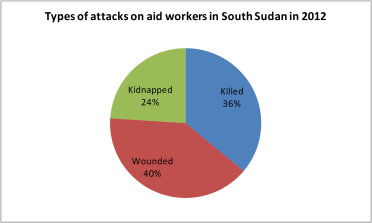
Types of attacks on aid workers in South Sudan in 2012

There are 17,000 aid workers in South Sudan, making it one of the largest aid operations in the world. In 2012 there were 25 major attacks on aid workers, which puts the rate of major attacks on aid workers in South Sudan at 147 per 100,000 (that is a risk of 0.1% per year).  This includes aid workers which were killed, wounded or kidnapped. The breakdown by type of attack is shown in the chart. .

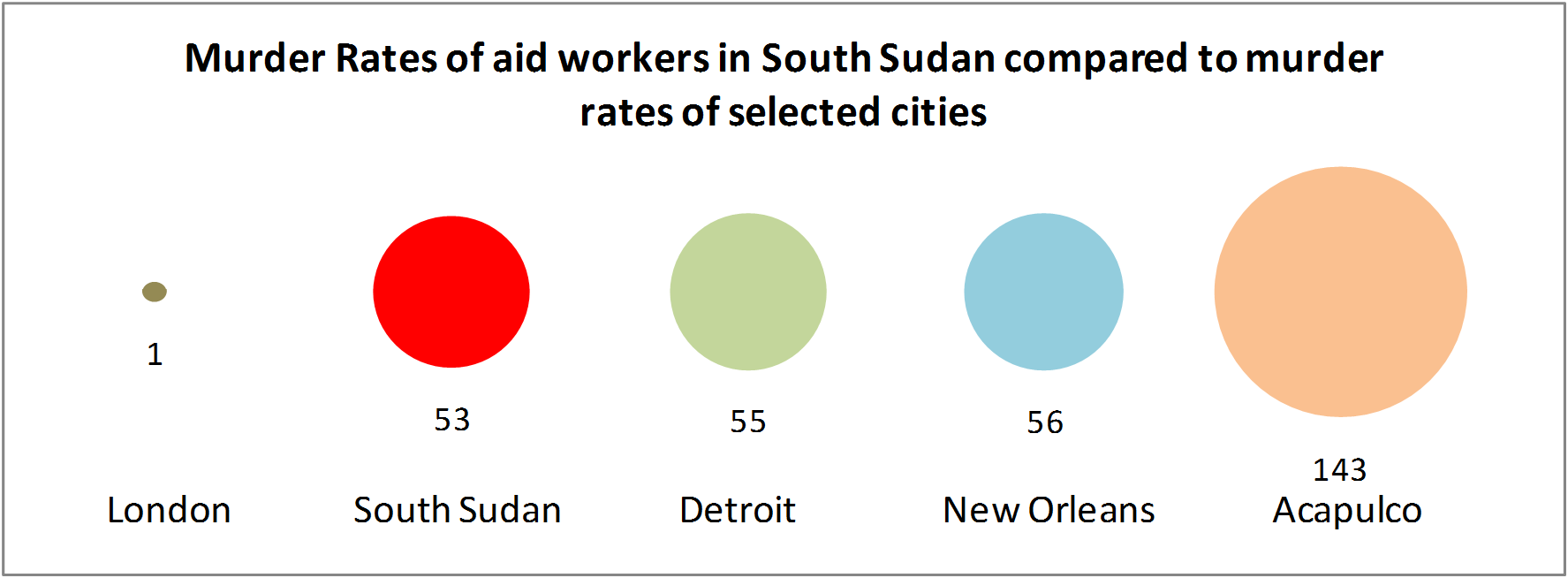
With 9 murders of aid workers, that puts the aid worker murder rate in South Sudan at 53 per 100,000. How does this compare to the murder rates of other places?

Murder Rates of aid workers in South Sudan compared to murder rates of selected cities

The murder rate of aid workers in South Sudan is 44 times higher than that of London. Or about the same as that of Detroit.

While violence is a great concern for aid workers, diseases and accidents account for a much larger proportion of events which lead to medical evacuation, hospitalization or death. For expatriate aid workers, violence is responsible for only 9% of deaths, medical evacuations and hospitalizations. Accidents account for 13% of cases, whereas illnesses are responsible for 78% of all cases.

You may point out that strictly speaking, you can use that statement to prove that all risks are tiny - to which i reply HOLY SHIT WATCH OUT FOR THAT DOG!

From the studies discussed in the previous blog, one can guesstimate around 10% of aid workers in South Sudan will contract malaria. While I don’t have data on other diseases, it would be reasonable to assume they would add up to a considerable risk. Over a third of aid workers in South Sudan will suffer deteriorating health. I don’t have a figure for the risk of aid workers to traffic accidents in South Sudan, but this will be high, somewhere between the risk of a major attack and the risk of contracting malaria. 40% of aid workers will find their deployment more stressful than they expect.  10% will suffer from anxiety and 20% from depression. Once deployments are finished, there will be a risk of longer term effects, both physical and mental, but there is little data to quantify this risk.

Finally, I have no idea of my risk of dying to a black mamba. And while I try to accept that in a long enough time scale my survival probability will drop to zero, I very much hope a black mamba isn’t involved. In fact, as Woody Allen put it, ‘I don’t want to achieve immortality through my work. I want to achieve it through not dying.’

This is the final blog in a three part series on aid workers and risk. Part 1 is available here and Part 2 is available here.

___

Sources & further reading:

Here is the statement from Toby Lanzer, South Sudan’s Humanitarian Co-ordinator, where he mentions the number of aid workers in South Sudan.

Data on events which lead to medical evacuation, hospitalization or death come from this study by Rowley et Al. Recommended if you are looking for academic works which analyse rates.

Data on numbers of aid workers killed or seriously injured comes from Humanitarian Outcomes (2013), Aid Worker Security Databasehttps://aidworkersecurity.org/. Note the 2012 data has not yet been verified.

Murder rate data: the data on murder rates from London was obtained here. Data from other cities is from a yearly report by the ‘Citizen Council for Public Security, Justice and Peace’ think tank.

Book Review – Missionary, Mercenary, Mystic, Misfit

Following on from our recent literature-themed blogs, Aid Leap has been generously sent a copy of blogger J’s new book ‘Missionary, Mercenary, Mystic, Misfit’ to review.

MMMM cover

Given our bemoaning the dearth of creative works about the aid world, we were particularly excited to read a current piece of aid fiction.

‘Missionary, Mercenary, Mystic, Misfit’ is a rip-roaring tale of love and disillusionment set in the dusty offices of Dolo Ado refugee camp in Ethiopia.

The protagonist, a young, idealistic aid worker called Mary-Anne is forced to confront her choices about work and love, and learns some hard lessons about herself and the reality of aid work. The ruggedly dashing Jon Langstrom struggles with the conflicting demands of family separation and a challenging senior posting.

Other characters flesh out the narrative and add flashes of colour. The brash CEO Mark is an archetypal baddy. Left-at-home mum Angie inspires exasperation, but you can empathise with her situation. Mulu Alem, the Ethiopian coordinator weary of endless NGO bickering, is a welcome addition into an otherwise heavily expat-centric cast.

It is a chomping, entertaining read full of outrageous clichés and a quick moving plot. For those who work in the humanitarian sector, it covers familiar territory and you can find yourself quickly relating to the characters and the situations they find themselves in. This is just the sort of thing you would want to settle down with after a long day in the field, preferably with a cold beer.

The world itself is well drawn and populated with some brilliantly incisive observations. Places such as the expat bar ‘Billy Bob’s’ are immediately recognisable, and descriptions of the heady, alcohol fuelled and often farcical settings are nicely done. Likewise, descriptions of the gritty day-to-day challenges – gruelling office hours, the political wrangles of securing funding and constant in-fighting amongst NGOs are spot on.

This is a book written by an aid worker, for aid workers, and has all the comfort of a shared in-joke – but with the consequent alienation for those uninitiated. The liberal dosing of acronyms and industry jargon can render the book impenetrable for anyone not well versed in aid speak.

J clearly knows the environment inside out. He is a canny writer and a master of the snarky blog. However, his fiction writing does not always have the same ease and can lapse into laboured, uncomfortable phrasing – such as the description of Somali refugees as ‘scared, too-skinny, intense, chocolate-colored.’

The characters fit well with the rambunctious style (think Jilly Cooper meets a UNOCHA coordination meeting) but at times the more crudely drawn, superficial personalities can grate. Mary-Anne is a sympathetic character, but her dazzlingly blond good looks and meteoric rise through the ranks are a bit much to stomach. Her distant boyfriend Jean-Philippe is not properly developed beyond the stereotype of a passionate MSF Frenchman, and serves mostly to offset Mary-Anne’s relationship with Langstrom.

This is coupled with some odd plot vehicles. Operations Director Brandon’s disappearance is never satisfactorily dealt with. The final twist was somewhat unbelievable yet predictable, having been obviously built up since the start – and added nothing to the plot except a sense of anti-climax.

The book’s real strength is its sense of immersion into the aid world. The career challenges that Mary-Anne face are realistic and well observed, and her conversations with Langstrom are a useful resource for any eager young aid worker. Though Langstrom’s career recommendations do sometimes feel like advice for the reader rather than natural prose, it is nonetheless interesting and makes sense within the narrative.

All in all, ‘Missionary, Mercenary, Mystic, Misfit’ is an enjoyable, rollicking stomp through the hinterlands of a humanitarian field mission. Highly recommended for a long airport layover or evening off – and you can pick it up on Amazon and Kindle. It is great to see pieces of fiction finally emerging – the question is, where are all the others?

Making Evaluations Work

Evaluations should enable development practitioners to learn from current programmes, and improve future ones. Sadly, they currently fall far short of that ideal. Most evaluations are short, shallow, and completely ignored. There are a couple of reasons for this:

Evaluation Cartoon

From the brilliant http://freshspectrum.com

  • Bad knowledge management. Large NGOs and consulting firms may commission hundreds of evaluations a year. However, these are generally not stored publically, and often not stored internally either. Consequently, there is no way for this information to be used for anything.
  • Easy to suppress negative evaluations. While some evaluations do get read, they will generally be the positive ones. It is extremely to suppress any negative evaluations.
  • Poor design. The terms of reference for evaluations are often impossible to implement. They may have vague or inappropriate evaluation questions, or pack a huge number of questions into a very limited number of days.
  • Poor execution. Evaluation consultants are often underqualified and overworked. Especially for more technical jobs, they may just not have the skills or knowledge required.

This is ultimately a problem of incentives. There is no real incentive for evaluations to be transparent or high-quality. Neither donors nor NGOs have any desire to showcase their failures, and overwork and staff turnover prevent them from learning from experience. Donors sometimes hold organisations accountable for the result of evaluations – but they seldom consider the quality or appropriateness of the work.

So what could the solution be? I believe that we need a peer-review system for evaluations, similar to that for academic articles. This could establish and utilise criteria for a quality evaluation, and the peer-review itself could be performed by academics, consultants, or monitoring and evaluation specialists at different organisations.

This can be linked to an evaluation database. Each planned evaluation should be registered before being conducted, and then the peer-reviewed report will be placed in the database, alongside the peer reviewing and any other relevant material. The Millennium Challenge Corporation offers a great example of this. .

This will need to be enforced and supported by donors, at least initially. Donors should signal that participation in this quality assurance process will be rewarding for the organisation. Perhaps bids that commit to this approach could be favoured over those that don’t.

If successfully managed, this could address a number of the problems that begun this article. The design and execution may still be poor – but with the knowledge that the evaluation will be peer-reviewed and openly available, there are greater incentives to improve. It would no longer be possible to cherry-pick the best evaluations for publication. Finally, and perhaps most importantly, all these evaluations would be readily available, so the knowledge wouldn’t be lost.

There are of course challenges facing this approach. The database would need to cover a wide range of potential evaluation types, and not be trapped into only considering a certain approach (such as randomised control trials). Finding peer reviewers would be the hardest part – this may need to be a paid rather than voluntary role, especially given the time pressure to produce and use evaluations.

Such a database could be managed by a small, independent secretariat. The best approach, however, would be for it to be taken on by an organisation specialising in evaluations; perhaps ODI or IDS, 3ie (if they can get over their RCT obsession), Learn MandE, or Better Evaluation. Any takers?

p.s. If you enjoyed the post, see our discussion in the rough notes page, and please leave your comments below!

p.p.s. I noted after writing this that the Big Push Forwards conference report proposed a different but related idea:

Promoting a ‘kite mark’ for evaluators and purchasers of evaluations who ascribe to certain ethical, moral and developmental standards of monitoring, evaluation and impact assessment. This would seek to create a ‘guild’ who would promote these standards and in so doing publicall and confront poor evaluation processes, evaluators and in appropriate ToRs.

ROUGH NOTES – Making Evaluations Work

Here are our rough notes on Making Evaluations Work. Please add your own comments in the main post!

P: There are lots of evaluations which are already publicly available (e.g. just the World Bank publishes hundreds of evaluations yearly). One of the main problems with regards to evaluations is that very little learning is done from all the available evaluations: making more evaluations available won’t solve this problem. Part of the reason for this is that carrying out a systematic literature review in one area is a very time consuming job (often about two years in academia, so should be similar here?)

R:  True. There are a lot of evaluations available – but bear in mind that this covers a huge range of countries and type of programmes. Although a lot is published, the amount available on any individual subject (as almost all systematic reviews start off by noting) is actually quite minimal. So having more available would still be valuable I think. Especially as the World Bank tends to evaluate a relatively limited set of projects, in a relatively limited set of ways – not much humanitarian work, for example.

Systematic reviews tend to focus on quite a narrow type of evaluation (primarily control groups), so tend to read a tonne of documents but only include a very small number. So I’m not sure how effective they are in many international development topics – but would be interested to hear more about that.

P: The system you suggest should lead to an increase in evaluation quality. But it would come at the expense of greatly increasing evaluation review time. While this would be fine for actual impact evaluations, these seem to be the great minority… In some humanitarian context, this payoff might not be worth it. As much as it pains me, timely mediocre information might be preferable to good information which comes too late.

R: That’s an interesting and important point. There’s a definite trade-off there. I think in most cases the increase in quality would be worth the effort – but not always as you say.

P: I’m unsure one organisation would be able to handle processing the sheer number of evaluations which are being carried out…

P:  I feel we’re carrying out way too many evaluations, often without much point. I think fewer evaluations with a bit more learning might be a better way to go.

R:  Agree with that as well. Or perhaps to have the existing evaluations far more specific. Evaluations tend to be very general – to evaluate the success of a project. It would be much better to have an evaluation which looked at one key, perhaps innovative approach of the project (how did the new accountability mechanism which they used help the project? for example) rather than trying to give an overall judgement..

P: There are quite a few problems with academic peer reviews (such as biases, which you refer to in your blog) – just to note that these same problems would be carried over. Though I still find a system with some shortcomings better than no system at all.

R: For some of those problems, see http://www.sciencemag.org/content/342/6154/60.full

P: Funding might be an issue with some of your suggestions, given the small proportion of programme spend dedicated to evaluations in multilaterals.

R: This relates to your previous point about resources. Funding is of course a concern – but you certainly wouldn’t use this system on anything more than a proportion of existing evaluations. Given that lots of money gets spent on evaluations as ti is (even though a small proportion of project spend) it would be worthwhile to do fewer, more high quality evaluations and end up spending the same

M: I would agree with both of you – that evaluations currently constitute poor knowledge management, and that a better system is needed to improve this. However – the concern with creating a system like you suggest runs the danger of too much work (creating a further layer of bureaucracy?), potentially diminishing the value of the subsequent output. Though as a peer-reviewed reference bank of evaluations then this could perhaps work.. Its certainly an important issue and a good idea. I would highlight the same concerns to the lack of proper contextual analysis that is actually built into programming, but that is a separate blog post… !

Aid Workers and Risk – Part 2

12567.strip

(c) Dilbert by Scott Adams

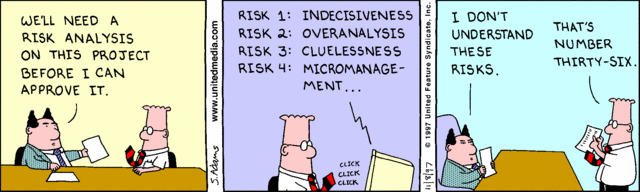
In my previous blog I looked at the number of aid workers who had been victims of major attacks, while I argued for the need of better data to analyse risks and rates. In this blog I’ll discuss other types of risks faced by aid workers, and show that in most environments, it’s these ‘other risks’ which are the main threat to aid workers.

Operating in a violent environment is a great risk for aid workers. In some areas it can be the main risk. Even if not the main risk directly, it indirectly affects many aspects of aid workers’ well-being contributing to other risks to their physical and mental health. But I feel there are other risks which are often neglected.

Data for aid workers who are killed in violent attacks tends to be very good, since these cases are frequently reported. Data on kidnappings is less reliable, as many are not reported. Data from non-violent threats, such road traffic accidents or malaria deaths is very weak. Data from other diseases is even weaker, and data on mental health of aid workers weaker still.

I would very much like to present you with a pie chart showing you the different components of the overall risk rates for aid workers, but the data is just not good enough. Instead, I’ll look at some of these other dangers faced by aid workers, and attempt to provide some estimate of the risk they pose based on the available data.

Road Traffic Collisions and Other Accidents
Road traffic accidents are believed to be one of the greatest danger to humanitarian aid workers. According to some, like Fleet Forum, they are responsible for the largest proportion of aid worker deaths. While there isn’t good data available on casualties of aid workers due to road traffic collisions, Fleet Forum estimates that around 25% of aid worker deaths are caused by traffic accidents.

Diseases
Studies have shown that over 35% of aid workers report deteriorating health during their missions. An ICRC study found one-in-ten (10.1%) of humanitarian aid workers returning from Sub-Saharan Africa had tested positive for malaria. Worldwide it was just under one in 20 (4.2%).

Malaria is just one of many other diseases which are endemic in many of the countries aid workers deploy to. Since I don’t have access to data, I will make an exception to my dislike for anecdotal evidence to point out health problems appear to be the main issue amongst the aid workers I’ve spoken to in South Sudan and India (note the emphasis: please don’t draw any conclusions from my anecdotal observations). I hear of people falling seriously ill far more often than I hear of aid workers being victims of violence or being involved in traffic accidents.

Mental health
A recent study showed over 40% of aid workers found their deployments more stressful than expected, which strongly suggests training and communication need to be improved. A study of 212 humanitarian aid workers from 19 different NGOs found symptoms of anxiety in three times as many aid workers post deployment as pre-deployment. For depression, the rates were twice as high post-deployment as pre-deployment. The study showed some of these effects were long lasting: three to six months post deployment, while there was some improvement in rates of anxiety, rates of depression were even higher than immediately post deployment.

Conclusion
So what does all this add up to? If calculating risk is difficult, so is working out the overall effect of all these hazards. Being an aid worker is dangerous, but it’s hard to quantify exactly how dangerous. A comprehensive comparative study found aid workers are approximately twice as likely to die than non aid workers. The risk is probably higher, as the study only looked at aid workers who died during deployment, and not those who died post-deployment as a result of diseases contracted during their deployment. The study also doesn’t tell us of the long-term health effects of being an aid worker.

Most agencies spend considerable time and effort addressing security, to minimise the risk to their staff. I am among those who applaud these efforts. But I’d also like to see more effort in measuring, communicating, and addressing other risks, especially in environments where these ‘other risks’ are greater than the risk of targeted violence. While dying from malaria or from a traffic accident might not attract headlines, it does leave you equally dead.
__
References and further reading:
Data on road traffic collisions comes from this report. This contains more recommended reading.
The Centers for Disease Control and Prevention (CDC) has published this overview of the risks to aid workers and how to mitigate them. It contains an extensive bibliography.

This section is rather short. Do you have any other reference materials to recommend? In particular, do you know of any comparative studies on the morbidity of aid workers? Let us know!

Aid Workers and Risk – Part 1

This is the first in a three part series on aid workers and risk. Follow us via email (click the link on the right) or twitter (@aid_leap) for the next installments. Part 2 is available here. Part 3 focuses on South Sudan and is available here.

Humanitarian aid work is a dangerous occupation: this is not news. Publications such as the yearly Aid Worker Security Report do much good to highlight some of the risks faced by aid workers. However, this blog argues both the nature and the risks faced by aid workers are misunderstood by many agencies and aid workers.

During a training  at a major INGO aimed at preparing aid workers for their first deployment, I was presented with versions of these two charts:

Image

Image

I was told the first chart showed the risks to humanitarian aid workers had increased dramatically in the last decade, while the second showed which countries where the most dangerous for aid workers. Unfortunately, as we’ll show on this blog, neither of those conclusions can be made from the data presented in these charts.

Without knowing the number of total aid workers, data on aid worker victims (either by country or by year) doesn’t provide much information. The graphs above don’t tell us anything about risk because they don’t have any information about the number of aid workers: has the number of aid workers stayed constant during the last decade? Is the number of aid workers in Somalia and Syria the same? I think not.

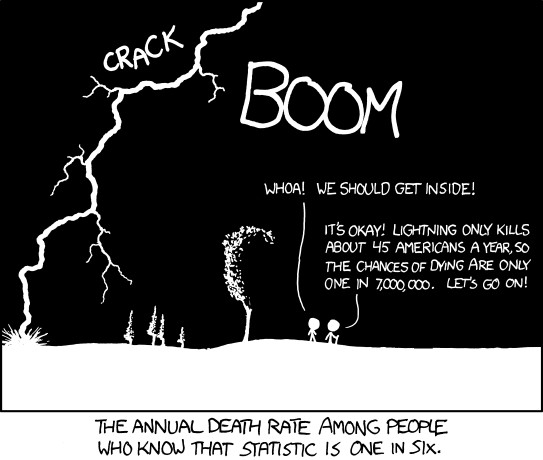
In the UK, London has 8 times more people killed or seriously injured in traffic accidents than Cambridge. But it would be very wrong to conclude London is 8 times more dangerous than Cambridge. London has more traffic accidents than Cambridge because it has a great many more people and cars.  The same applies to aid worker victims. All other things being constant, one would expect twice the number of victims if one doubled the number of aid workers.

From XKCD.com

From XKCD.com

There is very little available data on the number of aid workers in different countries/years. Most aid workers know just how difficult it can be to count the people who benefit from aid interventions. I feel we should have an easier time counting the number of staff. Humanitarian Outcomes, who are responsible for the Aid Worker Security Database and many works on aid worker security, are working on a new database to fill the evidence gap on the number of aid workers.

With the 2013 Aid Worker Security Report about to be published, we are likely to see quite a bit of these graphs. I’d like for more people to understand what they mean – and what they do not mean. Hopefully this year we’ll see less articles drawing the wrong conclusions from the data. In particular, I’m hoping for less articles claiming ‘The data says X country is the most dangerous for aid workers!’

We know that the number of aid workers has increased over the last decade. Without taking variations in the number of aid workers into account, the Aid Worker Security Report doesn’t demonstrate an increase in risk. I know the authors understand this well: they presented great data on risk in their Providing Aid in Insecure Environments: 2009 update. While I recognise the lack of data is a problem, I feel this limitation should be noted in the report, for the benefit of those who will mistake absolute numbers for risks or rates.

___

Definitions and further reading:

The misunderstanding is mostly due to a lack of understanding of the meaning of risk. There are many definitions of the word risk, but most of these relate to the probability of uncertain future events. Risk is a measure of probability. To understand risk, one has to understand probabilities. And therein lies the problem.

Aid workers should be interested in risks and rates (or relative risks and rate ratios, which are the comparisons of risks and rates respectively). Risk (also called absolute risk) is the probability that an event will occur. Whereas ‘rate’ is a measure of the frequency at which an event occurs.

Data for this blog was obtained from Humanitarian Outcomes (2013), Aid Worker Security Databasehttps://aidworkersecurity.org/, as well as from the Aid Worker Security Report 2013 Preview.

This link has a list reports drawing on data from the Aid Worker Security Database.

Prefer more academic papers? Death among humanitarian aid workers, while from 2000, is a good place to start. For a review of the literature over the last 5 years, you could try this paper.

Prefer reading blogs? You could try NGO Security.

Want more resources? Try some of these.

Is all of this too depressing? Comics about risk from xkcd here and here.

Are books relevant to humanitarians? Part II

As pointed out in the previous post, there is a healthy amount of aid literature. Though often insightful and interesting, these works are pretty inaccessible to the general public and not exactly the sort of thing you would relax to on your sofa with a cup of tea.

So what about aid fiction? Or, in fact, anything creative produced about the aid world?

‘Emergency Sex’ by Kenneth Cain et. al. is perhaps the first that springs to mind – though as fictionalised memoirs, I’m not sure this entirely counts. There is a forest of aid blogs scattered throughout the internet (yours truly included) – though again, most are first-person reflections and none fictional or purely creative. Some films and books do address aid work, but most incidental to the main narrative – such as Hotel Rwanda or Joe Sacco’s ‘Palestine’. The only purely fictional creative works that I can think of off the top of my head are the recent book ‘Missionary, Mercenary, Mystic, Misfit’ by blogger J of SEAL, the beautiful graphic novel ‘The Photographer’ about photographer Dider Lefevre’s journey with MSF in Afghanistan, and Jane Bussmann’s comedy show ‘Bono and Geldof are C***ts’. All fantastic, but three is still a rather sad total. If I’ve missed anything blindingly obvious then please do send suggestions through and lets boost this meagre selection – but I still suspect it will not be enough to establish a full-blown genre.

Image

Isn’t this completely baffling? For anyone who has spent any length of time in ‘the field’, it must be apparent that the creative material open to us is extraordinarily rich. You meet characters that even David Lynch would struggle to invent and government systems so positively Kafkaesque, they would be hilarious if they weren’t so terrifying. Some of the stories I’ve heard booted around bars and in compounds over a few beers defy the wildest imaginations and occasionally the laws of physics, and are so totally mad you just couldn’t make them up – such as the character (lets call him Mad Greg) who, back in the day, was in charge of a Sudanese hospital and formed a local paramilitary to blow a couple of his staff out of jail, and later holed up under siege in the hospital. Wouldn’t it be great if someone was writing this down?

The stage that we all perform on – the situations of war and violence where aid is made necessary should force powerful questions about the nature of being human in our modern world. As aid workers we peddle in the trade of death and life, bearing a dual blessing of being privy to the best and the absolute worst of humanity. And yet the acute frustration borne of impotence and insufficiency in the face of awful suffering, seems, for the moment, only to be expressed through blogs or formalised introspection. For centuries, the savage brutality of war has inspired legions of soldiers to write, draw, paint and put to music their experiences. So why are we so quiet?

Perhaps the sheer trove of possibility is simply too overwhelming, or too outrageous. Or perhaps everyone is just too busy.

Which is a shame, because a vibrant and critical artistic lens is, I think, a sign of maturity. A way of being able to question, poke fun at and expose an imperfect system to a public audience, in a way that isn’t clouded with impenetrable industry jargon.

So I reckon what the aid sector really needs is a proper, explosive call to arms. No more dry academic discourse, no more roundtable navel-gazing…

Frustrated with head office requesting the millionth round of corrections on a proposal? Screw them! Write a poem! Being forced to quietly toe the line as you watch a government abuse its citizens with impunity – just so you can keep that health clinic running? Pull out a paintbrush, create something epic! Felt that catch in your throat when you spoke with a mother and she told you quietly, proudly, that her child lives because of your emergency feeding programme – and you remembered why it is you do this job and that it is never enough but it is something. You, why are you so silent?

And if we aren’t honest about our failures, our struggles, then how on earth can we celebrate our successes?

So yeah, why not try and move beyond this narrow box of policy reports, blog posts and ironic Twitter updates that has become the only channel for frustration, discontent and joy.

Let’s see the initial weeks of a first phase response played out as a full-scale opera. Wagnerian overtures as helicopters chopper in emergency medical supplies … and then have to dump the load because someone screwed up the cold chain (whilst a chorus of chattering media/comms types gleefully exclaim the events in falsetto). Or perhaps a Sopranos-style sitcom set in the backwaters of some field base, where coordination meetings are ruled by OCHA’s answer to James Gandolfini…

You get the picture. Let’s do it!