Who protects Pakistan’s consulting industry? (Guest Blog)

Author: Nadeem Ul Haque, Former Deputy Chairman Planning Commission of Pakistan
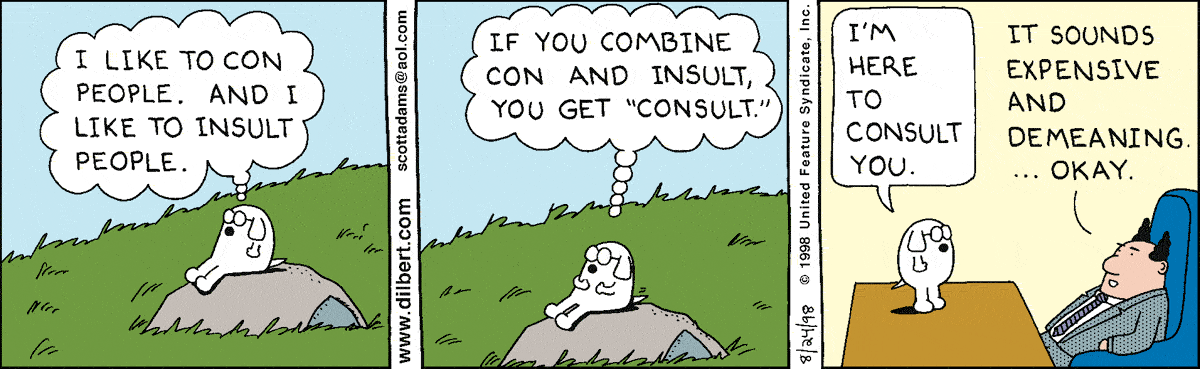
consultant cartoon

Ghari Baqir* returned to Pakistan with a PhD from Harvard 3 decades ago: keen to use his new-found skills to contribute to policy and thought in his homeland. Teaching at university provided an opportunity to do research, write books and perhaps at some stage advise the Government. He had ideas and wanted to work hard.

Soon he realized that professors were at the bottom of the barrel. In a society where power and wealth is everything, he had neither. His counterparts in the bureaucracy had power and healthy perks and plots, whereas all he had was a measly salary, no power, no perks. His tiny filthy office did not even have a phone (in that era before cellphones).

Luckily, donors offered him paid consulting opportunities and eventually he made enough money to buy his own house. In the process, sadly, dreams of independent research; his bright ideas; those books he wanted to write, were buried. Donor consulting meant working on someone else’s agenda. He wrote long, lengthy and often meaningless reports on poorly thought out projects. He reported to junior donor officials as well as their contractors who controlled money with little originality. The terms were very clear: Ghari could only dance to their tune.   

Ironically he was discriminated against. He was always paid ‘domestic’ rates which usually were half of what international consultants who worked with him got. Even though the international consultants were often not as well qualified as him. “Discriminated against in my own country” he says, “but who do I turn to?”

“So hungry is the Ministry of Finance (MOF) and External Affairs Division (EAD) for donor money, that they do not even question donor practices, quality or agendas.” His concerns received a deaf ear from EAD.

10 years later, his growing business allowed him to create a consulting firm in Islamabad. The firm grew and became very close to two of the biggest donors, as well as a subcontractor for major US consulting firms. Money was finally coming in.

However, the growth soon peaked. Donors didn’t give him the opportunity to compete with their own consulting firms. He knew the heads of these firms well and was well aware he could do as good as, and probably a better job than them. But fine print in the rules prevented him from competing. So he remained the junior partner, sometimes even just a mere logistics supplier.

For example, when X Consulting from Washington DC won a 100 million USD contract, his firm received just 3 million USD, despite doing the majority of the work. But X Consulting’s costs were higher, their consultants flew in and lived in 5 star hotels from where they instructed Ghari’s team.

He thought about expanding overseas but he could not compete with Western consultancies who had huge support from their home regulatory systems, and were the favourites of donors in all markets.

When last we met, Ghari told me that there could never be a Pakistani consulting firm of an international level in this sector as the game is loaded against us. I tried to encourage him by using cars as an example of where our Government has provided protection for national companies. I also told him about the National Tariff Commission which guards all industry in Pakistan from dumping practices. Their website shows ongoing investigations into Polythene, Soda Ash and garments for allegations of dumping as well as successful historical investigations. Then there is the Competition Commission which looks into anticompetitive practices and has taken stands in sugar and cement industries.

Following our conversation, Ghari marched off to all these agencies to plead his case. He had a hard time explaining what an ‘intellectual industry’ was. Everyone can see and use cars, but not thought.

Ghari had come full circle—starting out as a professor in a society where education and research had no value to becoming a sort of ‘thought’ entrepreneur in an environment where intellectual work is routinely subject to dumping by donors.

Even his original ideas do not belong to him. Consultants and donor agencies get the citation. Ghari is merely the ghost in the machine. As he would tell you himself, “History and our country’s experience has abundantly illustrated that development is a direct product of better ideas arising from thought and research. Yet in Pakistan, the Government unintentionally facilitate dumping on our ‘thought’ industry. It would seem they are marching to the tune of defunct economists.” 

* The individual’s name has been changed to protect them.

French Aid Worker reflects on Charlie Hebdo

Charlie Hebdo has polarised and monopolised public opinion. The events of early January in France have reignited debates about free speech, religious antagonism and access to information. And yesterday we saw an event about free speech attacked in Denmark.

The frenzy however, is not about Charlie Hebdo at all, but about what the magazine represents. It has been manipulated by media and political agendas alike.

Several contextual facts often left out of news reports are of importance. Firstly, Charlie Hebdo’s international fame comes almost entirely from the attacks that were made against it. It started with the firebomb thrown at their offices in 2011 and the attack against a German retailer selling the magazine. In their home country, the publication has always been on the fringe of French press, with a meagre 300 subscriptions/year. Right after the attack, it sold over 8,000 memberships within 48 hours.

Consequently, far from flaunting offensive cartoons, Charlie Hebdo was largely unknown and easily ignored by the wider population. The radicals that targeted it are responsible for making those images viral, not France, and not even the magazine itself.

Secondly, Charlie Hebdo is an anarchistic journal. They are anti. Anti-politics, Anti-Capitalism, Anti-religion, Anti-system, and most of all, Anti-symbolism.

Commentators who have used Charlie Hebdo as a platform to reignite arguments for or against free speech, civil liberties, or religious tolerance… have taken advantage of the momentum created by the event, but do not understand or care much what Charlie Hebdo is about.

Ironically, even the widespread I am and I am not Charlie movements have been using the magazine as a poster-child it never chose to be. Luz recently said in an interview*: “There is a symbolic burden that has been put on our shoulders, which doesn’t exist in our drawings and which is a bit beyond us. I am one of the people who has an issue with this”. He goes on to say the recent attacks have seen the magazine portrayed as either offensive provocation, or the “white knight of the freedom of the press”, when what they have always believed in is simply the “irresponsible nature of caricature work”.

The “Je suis Charlie” march was organised in the name of Charlie Hebdo, and supposedly in that of free speech, but saw some public characters condemned as “hypocritical” for their role in it. It was also a golden opportunity for Hollande to increase popular support for his party (which he successfully did). A political manipulation which aimed to foster a sense of solidarity but did not provide clear answers to important questions of taboos, social inclusion and anti-terrorism laws.

Should a comic, a cartoonist, a novelist or a movie writer be curbed in her/his creative rights so as not to offend some or part of the public? And if so, where does the censure end?

Should the moderate French Muslim population be unwillingly put under the spotlight to denounce the attacks perpetrated by the Kouachi brothers and Ahmed Coulibaly? Do they have a right to condemn those attacks but also refuse to condone the cartoons? Or simply to stay silent because they do not see themselves as more involved than any other non-Muslim French citizen?

The lawyer in me wants to scream that freedoms are, by definition, whole – which does not preclude self-imposed limits and consideration for people of different cultural backgrounds. The attack has already led to some new restrictions placed on civil liberties. For example, in France, 54 people were detained for “defending or glorifying terrorism”. The potential restrictions on civil liberties justified by the attacks open Pandora’s box, potentially leading to ‘…a new way of living – much closer, ironically, to the terrorists’ fantasy – without the rights, freedoms and values on which our society is supposed to be built and which in the darkest of times more than ever we need to guide us”.**

These attacks have succeeded in creating more visibility for the magazine they were trying to silence; but they have also highlighted questions of policy with serious legal ramifications which have yet to be answered.

* Luz is one of the cartoonists of Charlie Hebdo. He owes his life to being late to the targeted meeting the day of the attack.

** Shami Chakrabarti “On Liberty”

Why Don’t We Ever Learn?

I spent this New Years Eve in a pub with an old friend. We’d covered the normal topics of conversation – the love-lives of mutual friends, why our nostril hair is sprouting, how everything was better when we were young. Conversation shifted to our work, and I started rambling about my life as an M&E consultant.

“It’s all so pointless,” I said. (I’d had several pints at this point.) “I spend my time helping charities to collect high quality monitoring data – and then they just ignore it.”dilbert managing for results

“Why is that?” my friend asked. “That seems completely stupid.”

And I was stumped for an answer. Development charities are full of bright, enthusiastic, often very nice people, doing amazing things with limited resources. Why are they so slow to use monitoring data that could improve the effectiveness of their work? I spluttered a bit, then changed the topic and we spent the rest of the evening trying to balance a pint glass on a spoon. But it is an important question, and I’ve spent some time since then thinking about why we are so slow to learn from monitoring data. Here is a short, non-exclusive list of reasons that I’ve encountered through my time in the sector.

1)      Monitoring frameworks are useless. One reason why many programmes don’t use monitoring data effectively is that the monitoring data they collect is rubbish. Too many monitoring frameworks are geared towards measuring a small number of quantitative indicators, sometimes of little relevance to the programme. If the monitoring framework isn’t encouraging programmes to gather and think about a wide range of relevant data, it’s no surprise that they don’t learn much from it.

2)      Pressure to spend. Incentives are generally set from the top, whether this is the donors, board of trustees, or senior management of an organisation. If these pressures are primarily to spend money or conduct activities on time, it is no surprise that there is little interest in learning about whether these activities were successful or not. I worked in one humanitarian organisation which was spending money too slowly – a terrible sin in the aid sector. I remember the team leader strutting up and down in a meeting, waving a folder of paper above his head. “You need to spend, people!” he yelled, like a bearded Gordon Gekko. “Get out there and move some money!” Not exactly calculated to inspire thoughtful, reflective practice.

3)      Short projects. Even without the clear management dysfunction described above, short term projects often leave little time for staff to really learn from monitoring information. Imagine that you’re implementing a three year project. You probably spend at least a year setting up, finding teams, and running through an initial cycle of activities. If you find that this initial cycle of activities wasn’t particularly effective – perhaps you used the wrong partner, worked in the wrong place, or were targeting the wrong problem – this doesn’t leave you much time to fix it. Revising the programme could take another six months, which would mean that you’re half way through the project without having achieved anything. In this situation, most programmes prefer to ignore any evidence that things are going badly, and plough on regardless.

4)      Complex change processes. Sounds obvious, but learning from monitoring data requires some kind of process to allow organisations to feed this learning back into performance. This learning loop is often dysfunctional, and so revising plans and strategies is so much work that it’s easier not to bother. A prime example of this is DFID’s use of the logframe, a document which sets much of the strategic direction for their programmes. Although DFID guidance allows for – indeed, theoretically encourages – revision to the logframe, in practice it’s a massive pain to revise. By the time any changes have gone up through the organisation, been reviewed, argued over, and reviewed again by more senior people who give completely different advice, it just isn’t worth the bother. So although staff on the ground may be learning from monitoring data, there is no real process for this to feed back into the overall programme strategy. (Although this may be changing.)

5)      Not having a clue how to make things better. Finally, one of the key reasons development programmes don’t improve based on monitoring data is that they genuinely don’t have a clue how. Development is a tricky business, and programmes typically aim to do ridiculously ambitious things. Developing health systems, promoting economic development, and providing decent educations are all issues that developed countries have wrestled with for centuries – and they don’t do a great job of them. So if your monitoring data shows that the health system isn’t strengthened at all, then it could well be that the programme just hasn’t a clue what to do, and so continues doing the same thing that they know isn’t working.

Ultimately, good use of monitoring data comes down to strong leadership. Senior management needs to understand the importance of monitoring, and put resources and time into it accordingly. They need to resist organisational incentives to spend money, or to run projects badly, and actually care about what they’re doing. And they need to have a clear idea of what they can do, or inspire others to get a clear idea, and not be afraid to close down projects when necessary.

See a great response from Elina Sarkisova: “Could Paying for Results (finally) Help us Learn?” (and if you’re a real aidleap fan, then scroll down to the bottom to see our our response to her response…)

And also see our previous blog in this series: What have indicators ever done for us?

What have indicators ever done for us?

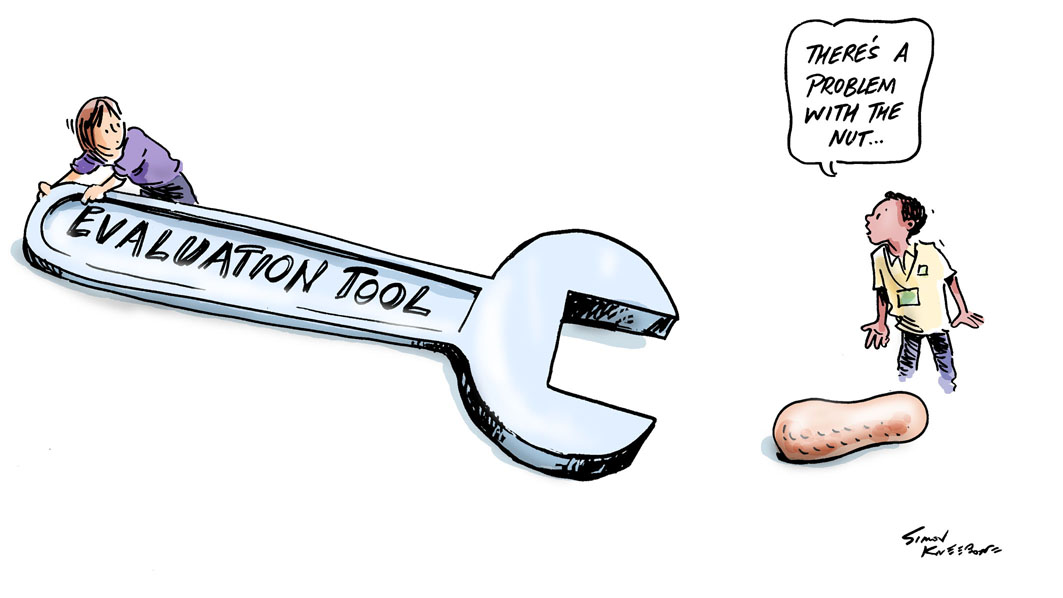
There is no shortage of indicators in the development sector. Monitoring and evaluation manuals typically stress their importance; they’re referred to as “the backbone of M&E systems”, which “enable reliable monitoring and evaluation.” As a result, they are demanded by donors, supplied by programme staff and consultants, and misused by more or less everyone.

From Simon Kneebone http://simonkneebone.com/

From Simon Kneebone http://simonkneebone.com/

An indicator is a simple idea; it’s a clearly defined, measurable metric. Progress against this metric will ‘indicate’ the performance of the programme. Typically indicators are defined in advance, and targets are set in order to see whether the programme is on track or not. Used correctly, indicators can indeed be a valuable tool. However, they need to be seen as one component of a good monitoring and evaluation system – rather than the ‘backbone’ of it. There are three reasons for this; indicators only capture a small portion of what you should measure, they are not good at capturing qualitative data, and they ignore unexpected information.

Firstly, pre-defined indicators are only a small portion of what you should monitor. Most M&E manuals suggest that you pick a few key indicators, but this risks blinding you to other important and available information. Even a short survey will gather information against tens or hundreds of potential indicators. For example, imagine that you run a survey to assess satisfaction with a health centre. A typical indicator might be ‘average satisfaction rates with the health centre.” However, this only captures a small part of the story. You should be interested in how satisfaction rates vary with gender, age, time or location. You might be interested in the distribution as well as the average; for example, are there some very dissatisfied clients? (And why?). Of course, indicators can be disaggregated, and more indicators developed to capture these additional factors. However, sets of indicators swiftly become too big to be useful, without capturing everything that you might want to examine. The key to good monitoring is flexible, imaginative use of data, not simply reporting against pre-defined indicators.

Secondly, indicators are not good at capturing qualitative data. This is not for want of trying; the OECD evaluation glossary, for example, suggests that indicators should be both qualitative and quantitative. Qualitative indicators may well be very useful in theory – but in five years working in monitoring and evaluation I’ve never seen one that made sense. Qualitative indicators tend to fall in one of two categories. The first is to present quantified opinions, such as ‘’90% of participants believe that the training course was great.” This can be very useful, but is not actually qualitative data. Alternatively, qualitative indicators can become so vague as to be useless, such as ‘participants were satisfied with the training course.’ Good qualitative data is, however, essential for understanding progress, sustainability, and success of a project. Since an indicator presents a single variable along which views can vary, it does not provide the open framework needed to collect good qualitative information.

Finally, indicators – by their nature – can only capture what you’ve predicted in advance. They consequently can miss unexpected changes or challenges. To continue the healthcare example, a good monitoring system should pick up if local beliefs conflict with the health services provided. It should help to build understanding of how global events – such as the recent outbreak of ebola – impact on your work. All of these could be essential to monitor, but very difficult to predict and set indicators for in advance.

Of course indicators are important. They can be a great communication tool, allowing a clear message to be communicated externally. For example, DFID sets consistent indicators across the organisation; this allows it to boast that, last year, they provided access to financial services for 54,450 people. (And, more mysteriously, that 85,806,000 people have choice and control over their own development.) Indicators can set strategic direction – as the MDGs have successfully concentrated international attention on service delivery in developing countries. Indicators are crucial for giving an overall understanding of a complex portfolio, helping managers to compare progress across different contexts using commonly defined indicators. Finally, defining indicators forces staff to think about the data they need to collect, and what success would look like.

Consequently, indicators should be seen as one component of a strong M&E system – rather than the core of it. Unfortunately, this isn’t always the case. I have conducted a number of consultancies to help organisations develop their M&E system, and after much confusion discovered that what the client really wanted was a set of indicators. The international development community as a whole places great stress on indicators, captured in logframes, results management systems, and endless guidance notes. But if you really want to create strong M&E systems which allow you to understand success of the programme, reasons for this success, and emergent trends, indicators aren’t the place to start.

See the next blog in the series: Why Don’t We Ever Learn?

Should the children of Liberia be in school?

childrenThe streets of Liberia are full of children. Some play in the dirt, others sell small items, whilst others wander about aimlessly. One thing is for sure, they are most often in pairs or groups: holding hands or with their arms round each other. One can’t help but wonder if they are truly safer like this than in a classroom? The Government of Liberia closed schools in August to protect children from the disease.

The Ebola Virus Disease is a terrifying illness and has claimed the lives of over 2,963 people in Liberia. Transmission of Ebola is through bodily fluids and so requires sufferers to be very close to others for it to spread. For this reason the Government of Liberia banned public gatherings, closed markets, and closed schools. The purpose was clear: to halt the rapid spread of this deadly disease.

The number of new cases has plateaued in Liberia. The exact cause of this is unproven but many believe that it is due to the change in behaviour of Liberians. On 13 November, President Sirleaf lifted the State of Emergency allowing markets to reopen once a weekend. As the Senatorial election campaigns kicked off this week, groups of candidate supporters were seen with over 4,000 congregating on Friday in central Monrovia. This prompted the Supreme Court to ban election campaigning in fear that Ebola transmission would soar again. However, the Government has not yet said that children could return to school.

Some parents have hired teachers to come to their houses and privately tutor their children. These parents fear that their children will fall behind and potentially be permanently damaged, economically, by this period without education. But not everyone can afford this. Other parents complain that they have no-one to look after their children whilst they are at work. The result is that often children are massed together and looked after by one or two community members during the day. Such child care is no better than having the children in a classroom, and if one of them fell ill it wouldn’t be long before others became sick. Or alternatively they are left alone in the home, which places children in danger of other terrible incidences.

Reports of young girls being raped in their homes while their parents are at work are increasing. A male survivor of Ebola carries the virus in his sperm up to 3 months after he recovers. The rape of young girls is terrible, but if this also leaves them infected with Ebola, the damage may be fatal.

So, is there an argument that children would be safer – physically and psychologically – if they were still in school? This would require certain measures to be put in place. With support, teachers could be taught infection prevention controls and how to identify the symptoms of Ebola. Each school could have chlorinated water at it’s entrance and electronic thermometers could be used to check the temperature of every child before entering school. Each school could have a nurse on hand to support if a child does fall sick. Every night the classrooms and toilets could be chlorinated to ensure decontamination. This would obviously be costly and resource intensive. But with the international aid sector sloshing about in the capital wouldn’t it be feasible? Having children back in school would keep them from child labour, other diseases they can pick up from hanging about in the streets, protect them from abuse and rape, and keep their minds engaged.

President Sirleaf has announced that a team of investigators will look in to whether schools can start to reopen in January. By this time children will have been out of formal education for 5 months. And in certain areas of the country, called ‘hotspots’, they have already said they will not reopen schools. Liberia already had a poor quality of education but significant work is going to be needed to get it back up and running. Many teachers have had to seek other jobs to pay their bills, others have died. At the height of the outbreak it was correct to close schools in particular areas, but the quicker they could have reopened, with the correct measures in place, the less economic and potential psychosocial damage would have been done.

For an introduction to the Ebola virus try Peter Piot’s No Time to Lose

Is there too much “innovation” in development?

A friend of mine – let’s call him Bobby – recently asked me for help on a bid he was writing which needed to include “innovative approaches”. Bobby expressed a clear dislike for the Developmentspeak term “innovation”. For Bobby, the term is just a fad.reinventing the wheel

So do I agree with Bobby?

The term “innovation” has become a popular buzzword in the development sector. There are plenty of examples, from USAID’s Development Innovation Ventures, to UNICEF’s Innovation Unit. The Guardian featured “12 days of innovations” over Christmas in 2013, profiling “eye-catching innovations in development”.

I do see some advantages to an emphasis on innovation.  Calling for programmes to be more “innovative” encourages them to experiment more and try different solutions. This could generate unique ideas and new ways of approaching problems – just take a look at TechChange, Commcare, or FrontlineSMS.

However, many ‘innovations’ don’t actually contribute anything new, or do anything different. For example, I don’t see how telemedicine – using telecommunication and ICT to provide care at a distance – can today be seen as an innovation. Allowing patients to speak to health professionals over the phone came about in the UK in 1998 with NHS Direct!

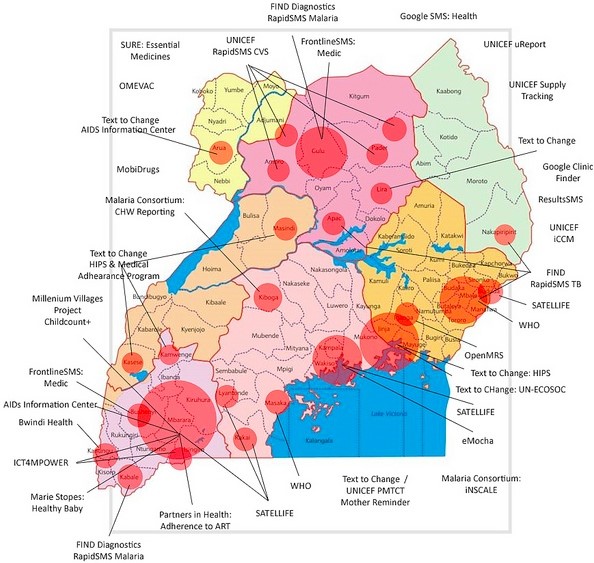
Furthermore, there is a proliferation of pilots across the globe that are not being scaled up. A good example is mHealth, using mobile technology to help improve health. In 2008 and 2009 Uganda had 23 mHealth initiatives that did not scale up after they were piloted because the initial funding had dried up (see image below). It has reached the extent that some criticise the situation as a “pilotitis; a term used to describe a scenario where many NGOs are funded for relatively similar, but isolated, pilot projects, resulting in no resources left for scaling them up.

Map of Mhealth Pilots in Uganda. Source: Sean Blaschke, Technology for Development Specialist at UNICEF Uganda

Map of Mhealth Pilots in Uganda. Source: Sean Blaschke, Technology for Development Specialist at UNICEF Uganda

The problem with “pilotitus” is that a lot of money is being wasted on these projects and the government has no idea what’s going on. In Uganda, it led to a moratorium on all mHealth projects being issued by the government.

What’s more, mHealth “innovations” have rarely been well monitored and rigorously evaluated. We need to ensure that monitoring and evaluation is taking place so that we know what’s going on and what works. This will (hopefully) mean that we can learn for future projects and reduce the risk of re-inventing the wheel.

So I ask myself again, do I agree with Bobby’s scepticism about innovation?

Encouraging innovations has led to great advancements and saved lives. I believe we should still encourage it, but always ensure that frameworks are in place to effectively monitor and evaluate these programmes’ progress. What do you think? Are innovations in the aid sector worth it?

What does it really mean to work on the ebola response

Recruitsignment for the ebola response continues unabated. There still aren’t enough volunteers to fill the positions needed. And with small INGOs joining in now, the numbers required are not going to reduce any time soon. Most NGOs have international staff on short contracts: 2 – 8 week rotations. This means that by the time you’ve hired someone, you need to start finding their replacement. Some positions are being transferred to national staff but they are justifiably fearful too.

So what is it really like working in West Africa right now?

The biggest difference is not being able to touch people. It’s weirdest when you meet new people, especially colleagues. You stand awkwardly a meter away and nod. But both of you are fully aware of it. Then comes the second meeting when you automatically want to reach out and touch them in that way we do to reaffirm the connection – a pat on the back or a brief touch of the arm. Again you can’t and the relationship seems rather formal.

In some places there are people who open doors for you. This is mostly in hotels so I think is probably more of a hang on from courtesy but it makes you more conscious when you do have to touch the door handle because there isn’t someone there opening it. The same handle that tens of other people have touched. Some people kick the door open with their feet. Others use a scarf or carry around a handkerchief. You would have to be really unlucky to catch it this way as the virus only lasts for 30-60 seconds outside the body when in a droplet of fluid.

Bars no longer sell peanuts or other nibbles with drinks. Some say this is because they can no longer import them, others tell you it’s because they don’t want to encourage the sharing of germs in one bowl. Passing a piece of paper to someone is also some how more awkward here. Paper can be a host for the virus, but again it would have to be very quick direct transmission e.g. one person’s blood from a cut on their finger goes directly in to the cut of the other person. And the first person would have to already be symptomatic.

Swimming is the new aid worker exercise of choice. Being surrounded by chlorinated water wins over the sweaty machines in the gym. Conversations in restaurants, no matter how juvenile, swiftly return to the topic of ebola: from gossip about the latest MSF workers sent home for getting it on to debates about how to have sex without breaking the no contact rule. 

Public health messages are everywhere. On the front doors of buildings, on the national ebola response cars, on the phone whenever you make a call, on shop windows. In some places this does seem to have encouraged behaviour change amongst West Africans – few people make contact now, chlorguninated water is a norm and no-one blinks when asked to have their temperature tested before entering a building. In fact, one of the most popular games seems to be ‘guess my precise temperature’ before being told.

In some areas things are going back to normal. Traffic jams emerge again at about 5pm. Many of the white 4×4 vehicles from the time of conflict have been resurrected: you can tell because they still have the no guns stickers on them. Some religious groups are starting to meet again as the fear of congregating dissipates.

As ever, there are some winners as the aid circus rumbles in to town. Food prices have soured and so eating out is more costly. Hotels are full of UN, INGO and Donor Government staff willing to pay outrageous rates. And as many aid workers still fear going out and about, or are busy and so want the most convenient lunch, these hotels and their associated restaurants almost have a monopoly on the aid workers per diems.

For an introduction to the Ebola virus try Peter Piot’s No Time to Lose

Training as if China isn’t a Country (Guest Blog)

Author: Hannah Ryder, Deputy Country Director, UNDP China.

Africa isn’t a country.

It’s an obvious statement but a while back, even American Vice President Joe Bidden forgot it when he said: “There’s no reason the nation of Africa cannot and should not join the ranks of the world’s most prosperous nations”.

Having worked in development for over ten years now, I think recognizing the wealth of diversity across the African continent – different languages, cultures, economics – is key.  There is no way you can understand the different problems facing the continent – and required solutions – unless you recognize its wealth of diversity.

But working in China I now have the complete opposite problem: I now have to remind myself that while China is indeed a country, its scale and experience is not like that of any other country.

China is almost a continent.

Screen Shot 2014-10-12 at 21.05.04

For example, by 2015, China is projected to have 3000 kilometers of urban rail networks, and by 2020, 5000. That’s half the size of East Africa’s entire rail network – urban and rural, let alone just in cities.  Over the next 10-12 years, the population of rural to urban migrants within China is forecast to be almost the size of the USA’s entire population.

There is also scale in China’s policy. For instance, according to a report UNDP China recently commissioned, China’s basic pension scheme covers 820 million people, and 20 million more people per year are expected to become eligible for it, meaning by 2030 it could cover the equivalent of the entire African population.

This scale makes China an excellent – and unique – partner for learning from on development. Since 1990, China has brought 600 million people out of poverty. But to do this, given its own scale and diversity, China needed a huge and varied number of policies and approaches.

This is where the facts that Africa is not a country and China is almost a continent come in. Here’s why.

One of UNDP China’s key stakeholders is an organization called the International Poverty Reduction Center in China (IPRCC), which started up in 2005, to help share China’s experience of poverty reduction and development with other countries. Since then, IPRCC has organized 60 training workshops for 1450 trainees from 97 countries.  And IPRCC is not the only organization that delivers this kind of training.  For instance, with the National Development and Reform Commission (NDRC), I recently helped to open a three-week long low-carbon development workshop. There were around 80 officials at the workshop – from Zimbabwe to Ethiopia – all from various ministries in their home countries.  These workshops are held twice a year, and many other Chinese ministries hold similar thematic workshops.  In fact, China’s recent 2014 White Paper on Foreign Aid provided statistics that suggest that between 2010-2012 around 1.5-2 seminars per day of around 25 officials were held!  I’m sure very few other countries in the world could manage this!

Yet the challenge of running such workshops, for such a diverse audience, is huge.  It makes attracting the right participants who will be in charge of deciding or implementing policies difficult – because that takes time to investigate and go back-and-forth on with stretched Chinese offices in recipient countries.  It makes tailoring the workshops to varied participants to make each part useful very difficult – as this might require re-design of the agenda or changing partners for various field-trips.  And critically, it makes follow-up of the workshops with individual queries or ideas for on-the-ground projects very complex.  On return to their recipient countries, participants can find it hard to create active partnerships with China.

Yet scale is good. Scale is needed, if poverty is to be reduced around the world. So how can China balance its scale with tailoring to a diverse audience?  Can China shift to meet the targets for numbers of people trained but also deliver more long-term results?

The fact is, although China is one country, being almost a continent, it has a great deal of diversity within it. It has potential to vary and adapt its training programmes. So UNDP is supporting China – and the IPRCC in particular – to try this. One example is a workshop we hosted a week or so ago, with a few mayors from Bangladesh. The mayors had visited China previously, and expressed interest in learning more about a particular service that local governments in China often use, called “one stop shop” centers. We helped IPRCC follow through this request, and tailor the workshop to help the Bangladeshi delegates work out how to adapt the “one stop shop” model to their situation, there and then.

We can’t be sure whether the mayors will actually set up the centers, but we think there is a much higher likelihood of this happening now, and our office in Bangladesh will remain in touch with them to support them if they decide to go ahead.

These new adaptive approaches are often suggested as useful for OECD aid donors. But China, being one country but almost like a continent, really has potential to excel at it, as China has experience as varied as the African countries it partners with.  Experimenting with (or piloting) a shift to a more tailored approach, plus following-up through our global reach – is something UNDP can offer to China, but more importantly to those countries – including in the diverse African continent – that want to learn from China’s experience to reduce poverty at home, and deliver long-term results.

What can NGOs learn from the private sector?

The not-for-profit sector is afflicted by a strange condition known as ‘private sector envy’. This is the unshakeable belief that not-for-profits are inefficient, bureaucratic, and boring, while the private sector is fast-moving, quick-thinking, and innovative. This deep-seated insecurity has worked its way deep into major donors; for example, DFID writes ‘business cases’, worries about their ‘commercial model’, and seeks to ‘maximise their investment’.

This is wrong for two reasons. Firstly, the not-for-profit sector can be hugely efficient. I started my career working for a small NGO in West Africa. With just five staff and unrestricted funding, it was innovative, impact-orientated, and a joy to work for. At a larger scale, the public sector has a long and distinguished history of innovations; the internet is a recent good example. (Thanks, US military!) In turn, the private sector can be quite incredibly inefficient, as anyone who has ever tried to change their gas supplier can testify.

More importantly, private sector envy often ignores the relative constraints and incentives of the public and private sectors. I realised this when I switched from working from large (and inefficient) charities, to private sector consultancies implementing donor-funded projects. Being afflicted by private sector envy myself, I honestly expected the private sector to be more efficient than the public sector, and it was quite a shock to find that it was just as bad.

After the initial frustration had subsided, I realised that the reason was simple – as a contractor, the private sector consultancy was now labouring under exactly the same incentives as the charities. They were risk-averse because the donor punished failure. They didn’t care about monitoring and evaluation because they didn’t want to uncover any negative news which might jeopardise their next bid. The HR department was useless because – well, HR departments are always useless.

When the private sector is more efficient, it’s often because they have clearer incentives and clearer metrics of success. In the public sector, by contrast, incentives are murky and often misaligned. Government bodies often want to spend their allocated budget and satisfy domestic lobbyists or constituencies, charities often want to get more money and expand. There is no simple metric of success which can be agreed on, unambiguously measured, and used to drive performance.

So trying to make the not for profit sector “more business-like” is a mistake. In trying to transplant practices from the private sector into the public sector, you risk getting the worst of both worlds. Management by results is a good example. Although better monitoring, evaluation, and tracking of results is certainly needed, most development projects cannot be managed by a simple dashboard of indicators. Current results management practices risk perverse incentives – encouraging a focus on the short over the long term, for example – and could reduce the intrinsic motivation of many working in the sector.

Instead, we should take inspiration from good practice wherever we find it – whether in the public sector, private sector, or behind the back of the sofa. We should pay attention to the incentives that programmes face, and recognise that these are mixed, ambiguous, and hard to set. We should measure success – but recognise that we can’t always attribute it and use it to drive programme performance. Finally, we should fire all HR departments.

Ebola Update – 27 September 2014

It’s been a busy year for the aid sector – Typhoon Haiyan/Yolanda in the Philippines, the worsening crisis in Syria, the outbreak of conflict in CAR and South Sudan, the recent offensive in Gaza, Ukraine, the reemergence of Iraq on front pages . . . and then there’s the forgotten or protracted crises in Somalia, the Sahel, DRC and Myanmar . . . and finally, the smaller but devastating crises such as the coffee rust in Central America and floods in Serbia. Reliefweb lists 46 current disasters.

140731114354-03-ebola-sierra-leone-horizontal-galleryBut despite all this, the Ebola Outbreak in West Africa is now centre stage and most predictions are that it’s going to continue to be for some months yet. Things are progressing rapidly as INGOs, the UN and Northern Governments are beginning to ramp up their responses. As an example, DFID now have a new Director in charge of ebola and what seems to be over 100 staff working on it.

Here is a summary of the key news and debates in the last week or so:

Basic Stats – Formal notification of the first case in Guinea was made by the WHO on 23 March 2014, so we are now 6 months on. On 21 September there was a reported 6,263 cases and 2,917 deaths. Liberia still has the greatest number of cases (3,280) and deaths (1,677). Cases have been confirmed in the laboratory in Guinea, Liberia, Nigeria, Senegal and Sierra Leone.

Who’s Done What? – The UK Government announces it will lead the response in Sierra Leone, the US sent 3,000 troops to do the same in Liberia and France is leading in Guinea (video of the French Minister speaking about their plans). From ‘Southern’ Governments, China has sent 59 health workers and Cuba has sent 165 medics to Sierra Leone.

Predicting Numbers – Many were concerned when CDC data suggesting tens of thousands more would die from ebola by January. Since then CDC has confirmed it suspects a worst case scenario of 550,000 cases. However, if this is corrected for assumed underreporting the figure becomes 1.4m by January (1). Next week we will hear whether the feared 8,000 cases will have been reported on 30 September. Even if this high total isn’t reached, the number of potentially unreported cases means that it is actually impossible to calculate the precise number of infected and deaths.

Lockdown – The Government of Sierra Leone called a lockdown across the country to try to identify all those with ebola and attempt to reduce the spread of the epidemic. There were mixed opinions on the success of the 3 day curfew: 100 victims and 56 new cases were found. Officials said this was a success. But MSF was concerned that it could actually result in further spread. But many were also worried for those who would be trapped without food and other necessities.

The Best Method? – This has resulted in a discussion of the different approaches between MSF and CDC about how to conquer the epidemic – this is summarised in a nice piece by CGDev.

United Nations – In an unprecedented move, the UN Security Council unanimously agreed a resolution on the ebola outbreak (2177). The US Ambassador to the UN Samantha Power had called for the resolution and this was the first time the Council had discussed a health issue as it’s useful remit is limited to matters of ‘peace and security’. A new UN mission named UNMEER is to be sent to the region to help with the response. Dr David Nabarro was named as the UN Coordinator for the response.

Other

  • 30 September – First ebola case diagnosed in USA
  • Analysts started to look at the causes of the epidemic with one suggesting it was due to neocolonialism.
  • The BBC World Service launched an ebola radio network with a 9 minute daily programme to help through local stories, correspondents and interviews, disseminate the latest information about the effort to contain and combat the disease.
  • Debates continue about what is the best PPE suit to use, what protocols are apt and how to facilitate the burial of victims.
  • A woman invents a way to care for her family using bin liners.
  • There was considerable debate about whether or not ebola could become an airborne virus. The conclusion is no.

References – The WHO Ebola Portal and The CDC Ebola Portal and the Global Ebola Response Coalition

Read our previous post on the Difficulties of Staffing the Ebola Response

For an introduction to the Ebola virus try Peter Piot’s No Time to Lose